
Student Work
Professional Production
Newsroom Partnerships
Professional Production
The Satellite Surge
Exploring the recent explosion of satellites – and what it means for the future of astronomy, the planet and the cosmos.

The long-term sustainable use of satellites in earth orbit requires an ongoing effort by all operators to limit the negative impacts of their actions.
- Sarah Thiele, et al "An Orbital House of Cards," 2026
The Lab is developing a series of professional productions, in partnership with major news outlets, that explores new storytelling technologies and formats. We are especially interested in deploying augmented reality, geolocation and strategies for taking journalism into the real world by adding an experiential component to our storytelling.
Our first project explores the rapid and unprecedented proliferation of satellites into lower earth orbit. According to the European Space Agency, there are about 16,000 operational satellites in space as of July 2026. In 2020, there were 2,700. The swift increase in satellite launches is happening despite the fact that the Earth’s orbit is a finite resource, and there’s a lack of settled policy about how to avoid the risk of spacecraft collisions.
As American and Canadian astrophysicists and astronomers have found, crash risk “is not the only issue.” There’s also residual issues we’ll have to contend with, ranging from the disruption to astronomy, pollution in the upper atmosphere and increased risk to people on Earth due to falling space junk. “By these safety and pollution metrics, it is clear we have already placed substantial stress on LEO [lower earth orbit], and changes to our approach are required immediately,” according to the researchers.
This dynamic and urgent development in space is the basis of a project currently under development by the Lab, which will result in a text article article and location-based experience to explore this issue and its possible solutions.
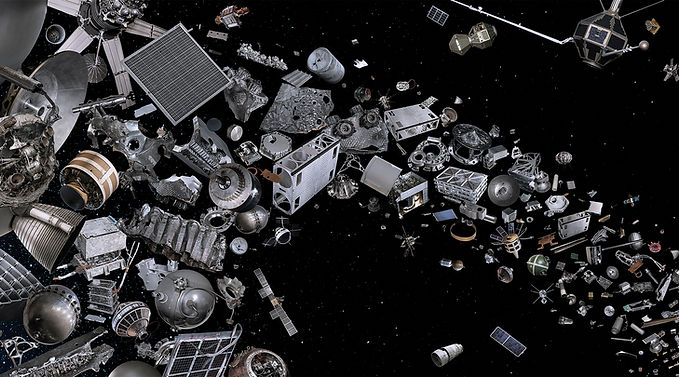
There are more than 29,00 objects orbiting the Earth. Every 11 minutes, an active satellite needs to maneuver to avoid hitting another satellite. Image Source: European Space Agency